
Arrest History in Prince George County
Prince George County Police is the main local investigative and arrest agency. The Prince George Sheriff serves criminal process, transports inmates, handles extraditions, and performs selected enforcement work. Virginia State Police may create a separate record for a trooper arrest. On Fort Gregg-Adams, the CASCOM Law Enforcement Activity handles on-post law enforcement. A task force or federal agency keeps the source file when it makes the arrest.
These records do not merge into one county database. An arresting agency records the legal basis, place, time, officer, and initial alleged offenses. Riverside Regional Jail records intake and custody. A magistrate records process and release conditions. General District Court receives misdemeanors and felony preliminary matters; a felony may later move to Circuit Court. Fingerprintable arrest data can also reach the Virginia State Police Central Criminal Records Exchange. Each source answers a distinct question, so a careful Prince George County arrest search compares dates, agencies, and case numbers.
Why Prince George Arrest Files Split
Prince George County has maintained a county police department separate from its Sheriff since July 1, 1995. It is one of only nine Virginia counties with both, according to the county. That split often trips up record requests. PGPD ordinarily holds a county police incident or arrest narrative. The Sheriff is the right office for questions tied to served criminal process, transport, or the office's own enforcement activity, but it is not a substitute police records desk.
The official PGPD records page shows where police reports and FOIA requests begin.
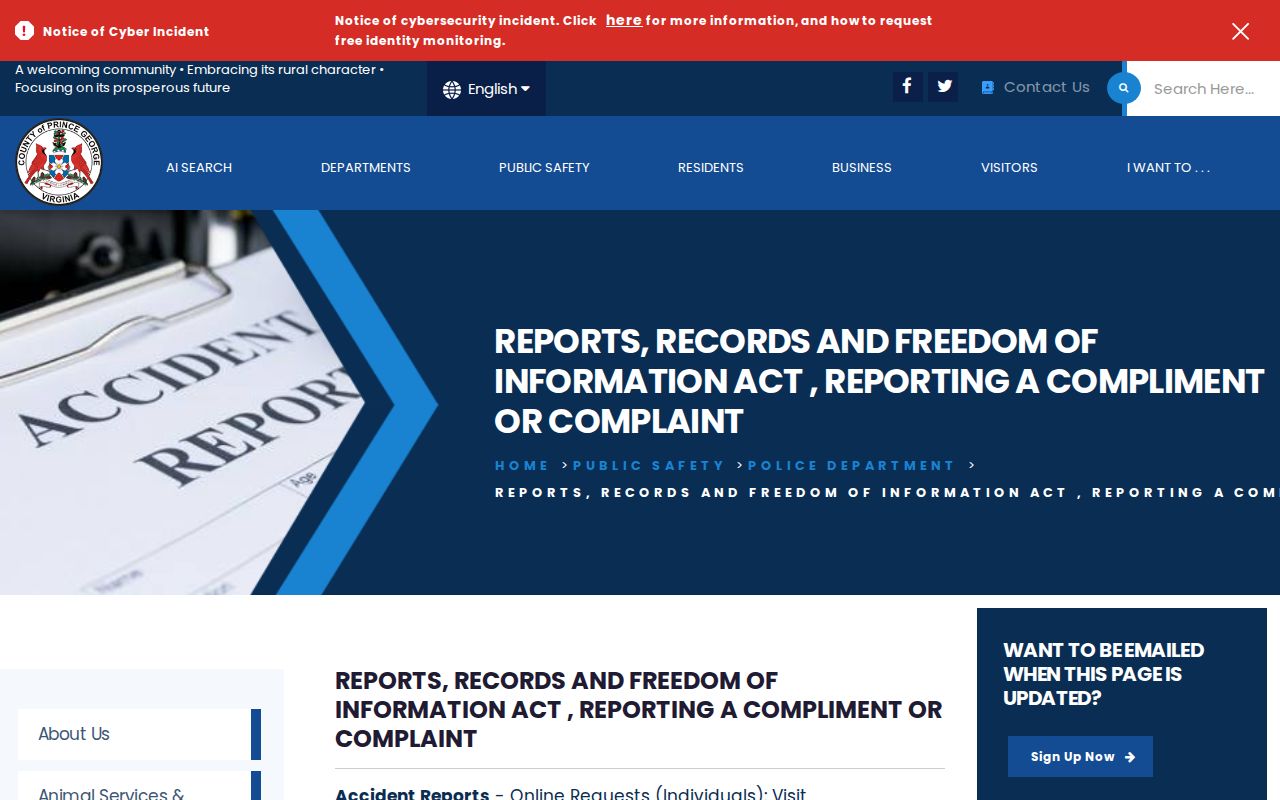
This county page confirms that the records channel belongs with police and the county FOIA process, while criminal-history checks go to Virginia State Police.
Prince George County Police
6600 Courthouse Road
Prince George, VA 23875
804-733-2773
Police arrest files route through county FOIA.
Prince George Sheriff
6601 Courts Drive
Prince George, VA 23875
804-733-2690
Criminal process, inmate transport, and Sheriff-created records.
How to Look Up Prince George County Arrests
No single search proves the full Prince George County arrest history. Start with live custody, then follow the arrest through police, court, and state channels. Use a legal name, arrest date, location, report number, jail ID, or case number when known. Those details help custodians distinguish records and help a clerk match an arrest to a court case.
- Open the Riverside Regional Jail homepage and follow its official inmate-locator link. If it fails, call RRJ at 804-524-6600.
- Search Prince George General District Court for a misdemeanor, arraignment, or felony preliminary matter. Check Circuit Court after felony certification or indictment.
- Request a PGPD arrest or incident file by email, phone, fax, mail, or in person through the county FOIA officer. Ask the creating agency instead for a trooper, military, Sheriff, or federal arrest.
- Send jail booking-record requests to RRJ's own custodian. A county FOIA request does not replace the jail authority's separate records channel.
- For an identity-linked Virginia history, use the notarized SP-167 request through VSP CCRE. The subject must authorize it; there is no anonymous instant state name search.
- After sentencing or transfer, check the VADOC locator for state custody and the federal inmate locator for federal custody.
Online court entries usually update on a schedule rather than at the moment of booking. Clerk contact remains important when a new case has not posted, the spelling differs, or documents are absent. The broader Prince George County criminal court case record supplies the filed charge and final disposition that a jail entry cannot.
Note: A no-result can reflect release, transfer, a posting delay, restricted information, or a search mismatch rather than no arrest.
Prince George Arrest Records by FOIA
Use the Virginia Freedom of Information Act channel when the public search does not supply the police arrest narrative. A request may be made by email to FOIA@princegeorgecountyva.gov, by phone at 804-722-8685, by fax at 804-733-2539, by mail to P.O. Box 68, or in person with the county FOIA officer at 6602 Courts Drive, third floor. Office hours are 8:30 a.m. to 5 p.m. on weekdays. No special form, written request, or statement of purpose is required.
Describe an existing Prince George County arrest record with reasonable detail. Useful facts include the event date, place, person's name, arresting agency, and report number. The county's optional FOIA form can organize those details, but Virginia law does not require it. The county normally responds within five working days by producing the record, withholding it with a legal basis, releasing part, reporting no located record, or invoking seven more working days. A criminal investigative file can trigger a separate 60-day procedure. Actual search, access, duplication, and supply costs may apply. Prince George waives costs below $5 and may require a deposit when an estimate exceeds $200.
The county's FOIA rights and procedures provide the source for these request rules.
| Police file | Send a PGPD incident or arrest request through the county FOIA officer. |
|---|---|
| Jail file | Email foia@rrjva.org or write RRJ's Office of Professional Review at 500 FOLAR Trail. |
| Court file | Ask the General District or Circuit clerk, not the county administrator. |
| Other agency | Request the record from the state, military, Sheriff, task-force, or federal agency that created it. |
What an Arrest Record Shows
A complete Prince George County arrest trail can span an agency file, an RRJ entry, a magistrate record, a court docket, and CCRE. The police file may contain more incident detail than the booking record. The jail entry is geared toward identity and current custody. Exact public fields can vary due to redaction, system access, and the stage of the case.
| Event identifiers | Report number, date, time, location, and arresting agency or officer. |
|---|---|
| Legal basis | Initial offense, probable-cause narrative, and warrant or warrantless basis where releasable. |
| Booking details | Jail ID, intake time, fingerprints, custody charges, and current custody or transfer event. |
| Bond and process | Magistrate process, release conditions, and public bond information when available. |
| Photo | RRJ takes a booking photo, but the public locator's live profile fields were not verified; no public-photo access should be assumed. |
| Court connection | Case number, arraignment, preliminary hearing, indictment, disposition, and sentence appear in the relevant court system. |
| State history | CCRE links a reportable fingerprinted arrest cycle with outcomes reported by the courts. |
Prince George Arrest Locator Limits
The Riverside Regional Jail locator is a present-custody tool, not a lifetime Prince George County arrest log. RRJ serves seven localities, so a result must be checked for the arresting agency and court. Its official link redirects to a numeric plain-HTTP endpoint that failed during research. The exact search labels, photos, demographics, bond fields, and housing fields could not be verified and should not be promised.
The official RRJ inmate locator endpoint is the direct custody-search source, though a browser may warn about its unsecured connection.
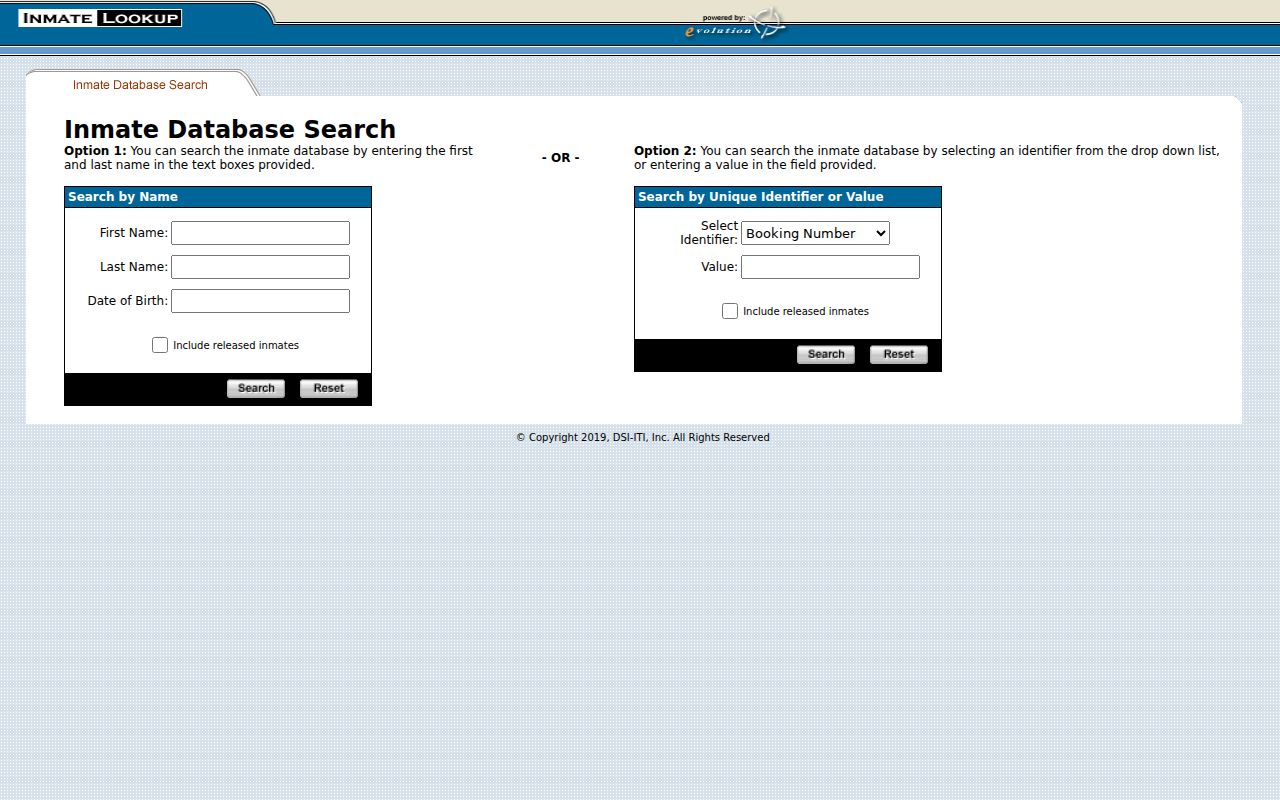
The captured interface shows why the phone and records-request fallbacks matter when the live endpoint will not load.
Call 804-524-6600 for permitted incarceration or charge questions. The RRJ public information answers state that future release dates are not released to the public. A person absent from the locator may have left custody, moved to VADOC after sentencing, transferred to federal custody, or never entered RRJ. For an old booking, request the jail record from foia@rrjva.org instead of relying on the live list.
Recent Arrests and Booking Logs
Prince George County has no official daily PGPD booking blotter and no county-run mugshot gallery. The official recent-arrest chain is RRJ current custody, the General District and Circuit case systems, and a request to the agency that made the arrest. PGPD press releases can add context in selected cases, but they are not a complete arrest ledger. Unofficial people-search and mugshot pages should not fill that gap.
The Riverside Regional Jail facility page describes the regional jail that books many Prince George County arrests.
RRJ uses direct supervision, with officers working within its housing pods, but the facility record still concerns detention rather than guilt.
A recent arrest can reach the sources at different times. The jail records intake first. Court data may post later, generally after its nightly update. CCRE relies on fingerprint and disposition reporting. The initial charge may change before or after the prosecutor files a case. Searchers should save the report, jail, and case identifiers rather than infer an outcome from one early entry.
Prince George Arrest Booking Flow
A PGPD arrest typically moves through several record events. Officers establish identity and check process, inventory property, and transport the person. RRJ performs intake, takes fingerprints and a photograph, records charges received, conducts medical and security screening, classifies housing, and tracks custody. A magistrate addresses probable cause and release conditions. The courts then schedule and resolve the filed case.
Arresting agency → RRJ booking → magistrate review → General District Court → Circuit Court when a felony advances → reported disposition to CCRE
That flow explains why the same Prince George County arrest can carry different labels. A police allegation, jail custody charge, prosecutor charge, and final court disposition are not interchangeable. For crash-linked incidents, PGPD also uses a separate report vendor. The agency-filtered CrashDocs search requires the report number, an involved party's last name, and the accident date; the published purchase price is $5 and access is limited to eligible recipients.
The three-field crash form is useful for the report itself, but it does not replace an arrest file, jail lookup, or court disposition search.
Fort Gregg-Adams Arrest Records
An incident on Fort Gregg-Adams may begin outside the ordinary Prince George County police chain. Since September 30, 2024, the Army's CASCOM Law Enforcement Activity has handled the installation's law-enforcement structure. The military police desk is 804-734-7400. Request the source record from that federal or military channel when its officers created the arrest file. A resulting federal charge belongs in federal court records, while an off-post local arrest routes through PGPD, RRJ, and the Prince George courts.
This boundary matters because Fort Gregg-Adams is a Census-designated place, not an incorporated city with its own municipal court. Prince George County has no incorporated cities or towns and no city police arrest desks. Nearby Hopewell and Petersburg are independent cities outside the county even though they share regional services such as RRJ.
Arrests vs Convictions
Probable cause supports an arrest. It is not proof beyond a reasonable doubt. A Prince George County arrest record shows that an agency took a person into custody or initiated arrest process. Only the court record supplies a judgment. Initial booking charges may be amended, declined, dismissed, resolved by nolle prosequi, or end in acquittal. A dismissal does not by itself erase the arrest entry.
| Point | Arrest Record | Conviction Record |
|---|---|---|
| Created by | Arresting agency and RRJ | General District or Circuit Court |
| Shows | Custody, probable cause, booking, and initial charges | Judgment of guilt and the resulting sentence |
| Best source | PGPD or creating agency, RRJ, and FOIA custodian | Court portal, clerk file, and reported CCRE outcome |
| May end with | Release, transfer, no filed charge, or a later court case | Sentence, appeal, or qualifying sealing relief |
Virginia provides traditional expungement for specified nonconviction outcomes and a broader sealing system under Chapter 23.2. Sealing bars public access but is not destruction. Anyone reviewing their own Prince George County arrest history should use current Virginia court forms and the clerk for the court that controls the eligible record. After relief, recheck the court entry and obtain a later VSP record to confirm reporting changes.
Note: An arrest is not proof of guilt, and the final court disposition should always be stated with its date.