
How to Check Criminal History in Prince George County
Begin with the free Virginia Judiciary Online Case Information System-Statewide Search, known as OCIS 2.0. It includes General District criminal and traffic cases, adult criminal matters in Juvenile and Domestic Relations District Court, and participating Circuit Courts. Repeat a broad result in the Prince George locality portals. General District records misdemeanors, traffic cases, and felony preliminary hearings. Circuit Court holds felony trials and appeals. Public online details for juvenile and domestic relations cases are sharply limited.
One result is rarely the complete Prince George County criminal history. A jail entry answers whether someone is in regional custody. A police file records the incident and arrest. A court file shows the charge pursued and its outcome. The VSP Central Criminal Records Exchange joins reportable, fingerprint-linked arrest cycles with dispositions reported to the state. Use a legal name, spelling variants, case number, and hearing date when known. Do not merge two people merely because their names match.
- Search OCIS and select Prince George in each relevant locality portal.
- Compare the court, charge, event date, and case number before opening a result.
- Check the Riverside Regional Jail custody locator when present detention matters.
- Request the incident or arrest file from Prince George County Police through the county FOIA channel.
- Order a notarized SP-167 from VSP when an authorized, identity-linked Virginia repository response is needed.
- Contact the correct clerk for pleadings, orders, certified copies, or an entry missing online.
Note: Court portals are indexes and status summaries; the clerk remains the source for the complete Prince George County criminal case file.
Prince George Criminal Records Have Two Agencies
Prince George County is one of a small number of Virginia counties with both a county police department and a sheriff. The departments separated on July 1, 1995. Prince George County Police is the primary investigative agency, so its records path is the usual starting point for incident and arrest reports. The Sheriff focuses on courthouse security, criminal and civil process, inmate transport, extradition, home incarceration, Drug Court, and other court-linked duties. A request sent to the wrong office can delay a criminal record search even though the buildings sit next to each other.
The official Prince George County government page shows the county department structure. Its appearance is captured below as a reference to the government source.
The county directory helps a searcher distinguish police records, sheriff process, courts, and the county FOIA officer before sending a request.
Prince George County Police
6600 Courthouse Road
Prince George, VA 23875
804-733-2773
Nonemergency: 804-733-2770
Prince George Sheriff
6601 Courts Drive
Prince George, VA 23875
804-733-2690
Court process and transport
The Prince George County Police page identifies the county's main law-enforcement office and contact details.
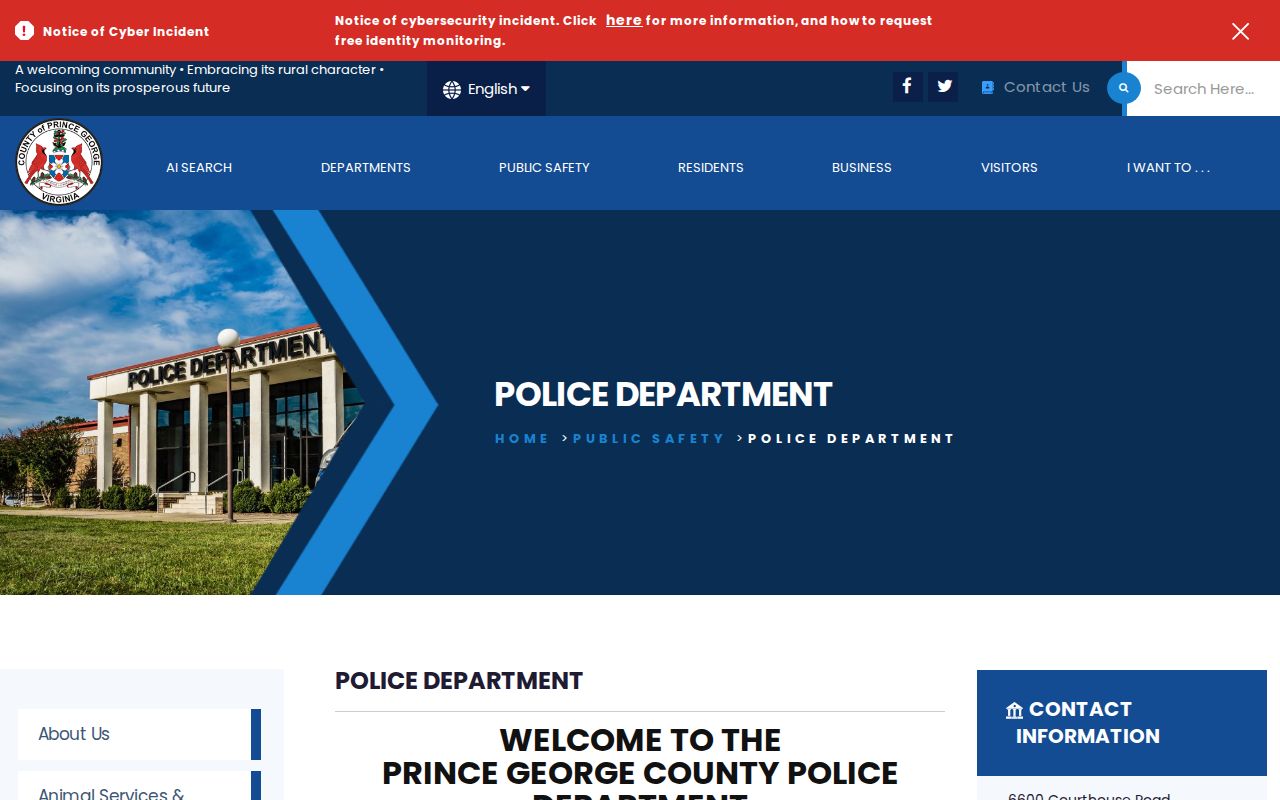
That police source, rather than a generic sheriff records desk, controls the normal route for county investigative files.
Official Virginia Background Checks
The Virginia Department of State Police Criminal History Record Check is the official general-public state channel. A subject completes and notarizes Section 1 of generated Form SP-167. If someone else will receive the result, that recipient completes and notarizes Section 2. One form is mailed for each request to VSP CARE with the approved payment. VSP estimated about 15 business days after receipt as of August 10, 2026 and offered no rush service.
This is not an anonymous instant name portal. It is an authorized request to VSP Criminal Justice Information Services and the Central Criminal Records Exchange. Program-authorized fingerprint checks use a separate Live Scan or fingerprint-card process tied to a qualifying program, account, and tracking number. No general-purpose fingerprint vendor location was verified in Prince George County. The program sponsor or law-enforcement agency should confirm the current capture site and appointment terms.
The official VSP page shown below explains the Prince George County criminal record request route and links to the current form generator.
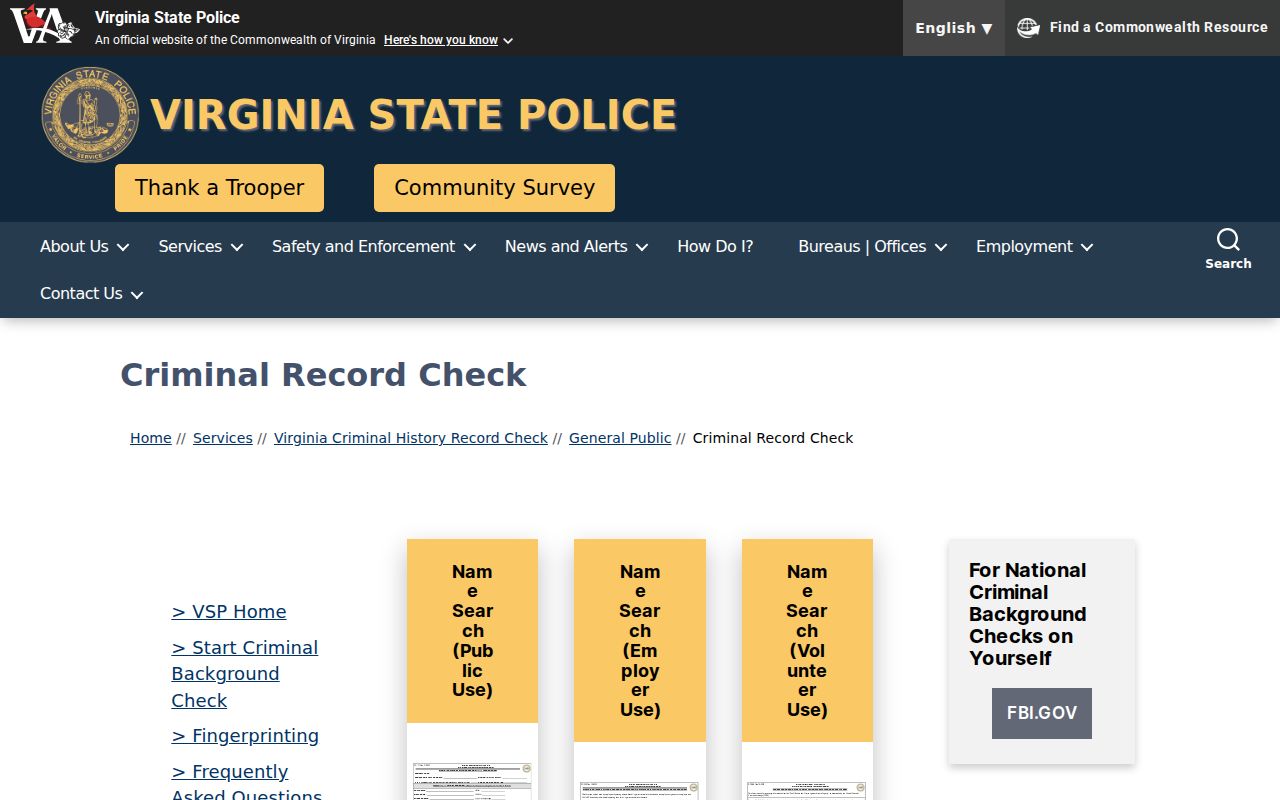
The live VSP instructions control if the fee, mailing address, form, or processing estimate changes after the research date.
| Official record | Documented fee | Access method |
|---|---|---|
| Virginia SP-167 name check | $15 | Generated, notarized, and mailed |
| Authorized Virginia fingerprint check | $13.75 state plus $13.25 FBI | Program-specific Live Scan or card process |
| Own FBI Identity History Summary | $18 | FBI electronic or mail request with fingerprints |
| Circuit clerk plain or electronic image | $0.50 per page or image | Request from the Circuit Clerk |
Note: SP-167 fees and timing reflect the August 10, 2026 research date; confirm both on the live VSP page before mailing.
Prince George Criminal Records at Courts Drive
One address holds three courts, but not one shared criminal record counter. Prince George Circuit Court, General District Court, Juvenile and Domestic Relations District Court, the Circuit Clerk, Commonwealth's Attorney, and sheriff court functions are based at 6601 Courts Drive. Circuit Clerk Deborah H. Edwards handles the felony court file and appeals from 8:30 a.m. to 5 p.m. The combined district clerk, Edmonia Michelle Frederick, handles the General District and J&DR counters from 8 a.m. to 4 p.m.
General District criminal arraignments are scheduled Monday at 8:30 a.m., with felony matters at 9:30 a.m. Circuit criminal court convenes at 9 a.m. and its terms begin on the third Friday in January, March, May, July, September, and November. Those times describe posted dockets, not a promise that a particular file will be ready at the counter. Confirm the case number and court first. The combined court also posts detailed dress rules, while the county publishes a separate electronic-device policy.
Prince George Circuit Clerk
6601 Courts Drive, P.O. Box 98
Prince George, VA 23875-0098
804-733-2640
8:30 a.m. to 5 p.m.
Combined District Clerk
6601 Courts Drive, P.O. Box 187
Prince George, VA 23875
804-733-2783 or 804-733-2781
8 a.m. to 4 p.m.
Types of Criminal Records
Each Prince George County criminal record answers a different question and has a different custodian. Police incident files describe reported events and investigative action. Arrest records document the basis and act of taking someone into custody. Riverside Regional Jail creates the booking file. Clerks maintain filed charges, hearings, judgments, and sentences. VSP CCRE maintains the identity-linked state history. A magistrate or court issues warrants, while law enforcement serves them.
- Incident and arrest file: request it from PGPD or the agency that created it.
- Booking and custody record: use Riverside Regional Jail for local detention facts.
- Criminal court file: use General District or Circuit Court based on the case stage.
- CCRE history: use VSP's authorized SP-167 process for a Virginia repository response.
- Supervision record: check the judgment, Riverside Criminal Justice Agency, or VADOC as applicable.
- Registry listing: use the Virginia Sex Offender and Crimes Against Minors Registry.
Records can disagree for valid reasons. A booking charge may be changed by the prosecutor. A court outcome may post after the CCRE arrest cycle. A person may leave the regional jail through release or transfer. Sealed and juvenile matters may be absent by law.
Note: A current custody entry, an arrest report, and a conviction record are different records and should never be treated as interchangeable.
Prince George Arrests Create Separate Records
An ordinary county arrest can create at least three distinct records. PGPD keeps the incident narrative and probable-cause material. Riverside Regional Jail records intake, custody, and charges received. General District Court then records arraignment, a misdemeanor case, or a felony preliminary hearing. A felony may later move to Circuit Court after certification or indictment. Fingerprints and qualifying data flow to VSP CCRE, and the clerk reports a qualifying disposition after the court acts.
Record flow: Police incident and arrest › Riverside booking › General District proceedings › Circuit felony case when applicable › reported CCRE disposition.
This split explains why a Prince George County criminal history search should not stop at a custody result. An arrest charge is an accusation. The prosecutor may amend or decline it, and only the court record supplies the disposition. A dismissed or nolle prosequi charge does not become a conviction, yet the arrest entry may remain visible unless it qualifies for expungement or sealing.
- Disposition
- The recorded result of a charge, such as conviction, dismissal, acquittal, or nolle prosequi.
- Nolle prosequi
- The Commonwealth elects not to prosecute that charge at that time.
- Capias
- Court process directing that a person be taken into custody.
- Indictment
- A grand jury's formal felony accusation after finding probable cause.
- Sealing
- A bar on public access that preserves access for parties the law authorizes.
What a Prince George County Criminal Record Shows
The contents depend on the source. A CCRE response groups identity data, aliases, arrest cycles, arresting agencies, fingerprint transactions, charges, and reported outcomes. A court file adds the case number, pleadings, hearings, counsel, orders, judgment, sentence, fines, restitution, and appeal activity. A booking record focuses on intake and custody. A police record may add the event narrative, evidence, officers, and reported property or injuries.
| Name & Identifiers | Displayed name, aliases, and source-specific matching data; protected identifiers are not public. |
|---|---|
| Arrest / Booking Data | Agency, report or jail identifier, date, custody charges, and status fields the custodian may lawfully release. |
| Charges & Statutes | Initial police counts, prosecutor-filed charges, or court codes depending on the record. |
| Disposition | The court result for each charge, including conviction, dismissal, acquittal, or nolle prosequi. |
| Sentence | Confinement, suspended time, probation, fines, costs, or restitution when applicable. |
| Custody / Supervision | RRJ local custody, VADOC state custody or supervision, and the court's probation order are separate sources. |
Read every field in context. Match the charge to its own disposition, then use the case number to obtain any order the public index omits.
Prince George Criminal Records at Riverside Jail
Riverside Regional Jail serves seven localities: Prince George, Charles City, Chesterfield, Surry, Colonial Heights, Hopewell, and Petersburg. Its adult detention center is at 500 FOLAR Trail, North Prince George, VA 23860, with a main number of 804-524-6600. The official locator is a current-custody search, not a conviction index. During research, its link redirected to an unsecured numeric HTTP address that would not load. A failed screen should lead to the jail phone and records channels, not an unofficial mugshot site.
The Riverside Regional Jail homepage is the source for its inmate-locator tile and contact information. No successful manifest image was captured for that page, so its official link remains the direct reference. RRJ does not give future release dates to the general public. A no-result may mean release, transfer to VADOC or federal custody, or no booking at Riverside.
The jail holds a separate FOIA channel through Lt. C. Jones, Office of Professional Review, at foia@rrjva.org. RRJ records are not requested from the county FOIA officer. Its 1,500-bed historic capacity and direct-supervision pod design describe the facility, not a current inmate count. Recent accreditation information should be checked on the jail site before it is quoted as current.
Public Access Laws
The Virginia Freedom of Information Act governs access to qualifying public records, but a criminal history is not one file subject to one rule. VFOIA provides a route to police records and permits actual search, access, duplication, and supply costs. Criminal investigative material may be withheld or released within statutory limits. Court case documents go to the clerk rather than the county administrator. CCRE dissemination follows its own law, and sealed records have separate access limits.
Key Virginia laws:
Va. Code §§ 2.2-3700 et seq. sets VFOIA access, exemptions, response rules, and actual-cost principles.
Va. Code § 19.2-389 controls CCRE criminal-history dissemination and a subject's own access.
Va. Code § 9.1-126 distinguishes court files, certain police data, statistics, and fugitive lists from regulated criminal history.
Va. Code § 19.2-392.2 provides Virginia's traditional expungement route for qualifying records.
Title 19.2, Chapter 23.2 defines the newer sealing system and authorized exceptions.
Juvenile data, victim-sensitive facts, Social Security numbers, active-investigation details, and sealed material may be withheld or redacted. Public access never turns an allegation into proof.
Note: The statute effective on the event or filing date controls, especially during Virginia's 2026 and 2027 sealing changes.
Prince George Criminal Records Through VFOIA
Prince George County Police incident and arrest files may be requested through FOIA Officer Charise A. Pastor by email at FOIA@princegeorgecountyva.gov, phone at 804-722-8685, fax at 804-733-2539, mail to P.O. Box 68, or in person at 6602 Courts Drive, third floor. The counter is open from 8:30 a.m. to 5 p.m. Monday through Friday. Virginia law does not require a written request, a special form, or a reason. Describe an existing record with enough detail for staff to locate it.
The county VFOIA instructions document the response choices, cost rules, and contact routes.
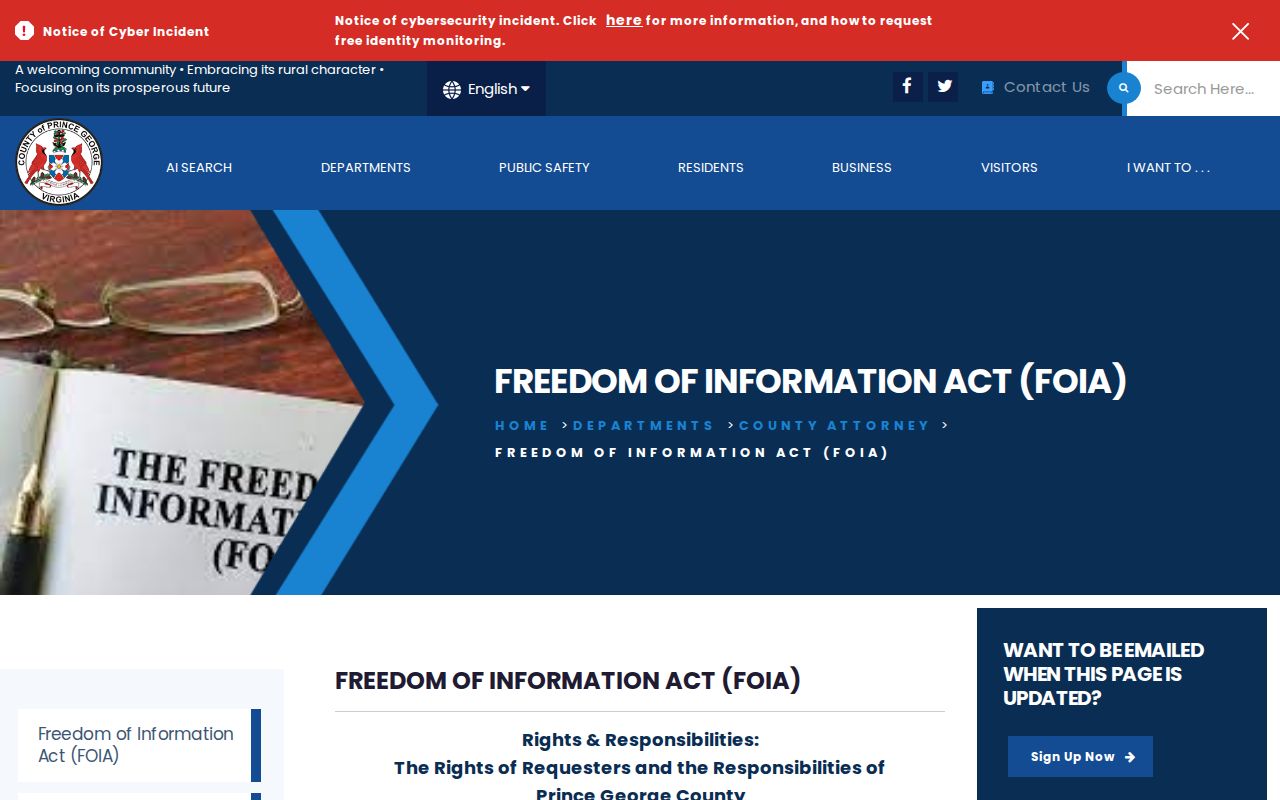
The county normally responds within five working days by producing records, withholding with a legal basis, producing part, reporting that no record was found, or invoking seven more working days.
Prince George waives costs below $5. It may require a deposit when an estimate exceeds $200, which pauses the response clock. A prior unpaid bill older than 30 days can be collected before a new request proceeds. Criminal investigative records can involve an added 60-day procedure. Ask for an estimate before work begins if cost matters.
| Record sought | First channel | Fallback |
|---|---|---|
| PGPD incident or arrest report | County FOIA officer | Phone, email, fax, mail, or in person |
| Court case documents | General District or Circuit Clerk | Online index, then clerk copies |
| Regional jail booking record | RRJ locator | 804-524-6600 or foia@rrjva.org |
| Virginia identity-linked history | VSP SP-167 | CCRE correction route for errors |
| Warrant or capias status | Issuing clerk or law enforcement | Sheriff or PGPD nonemergency |
Sealed, Expunged & Restricted
Virginia now uses two different forms of relief. Traditional expungement under § 19.2-392.2 focuses on qualifying nonconviction results, including an acquittal, nolle prosequi, dismissal, and certain identity or innocence circumstances. A successful order directs agencies to isolate the listed record. Sealing under Chapter 23.2 is broader. It blocks public access across covered repositories while preserving access for people and agencies the statute authorizes. Sealing is not physical destruction.
The modern automatic and petition sealing provisions became operational July 1, 2026. Eligibility depends on the exact offense, outcome, dates, waiting period, and disqualifying history. Use the Virginia judiciary's current criminal sealing forms, then confirm the correct filing court. Prince George felony matters generally involve Circuit Court, but the form and statute control where a General District record or petition belongs.
No verified Prince George filing fee or local clinic was found. Ask the clerk for the current amount and any fee-waiver process. After relief, allow processing time, recheck the portal, and order one's VSP record. If the entry persists, send the order and exact case and arrest identifiers to the reporting court or agency and VSP correction channel.
Note: Expungement and sealing are distinct Virginia remedies; the outcome, charge, date, and statutory path determine which may apply.
Prince George Criminal Warrant Record Checks
Prince George County publishes no verified public active-warrant search or downloadable warrant list. The Sheriff serves criminal papers and orders of arrest, PGPD executes arrests, and magistrates or courts issue process. A court portal may show capias activity, but it is not certified, real-time warrant confirmation. Search the related court case, then contact the issuing clerk, Sheriff at 804-733-2690, or PGPD nonemergency at 804-733-2770.
A warrant follows a probable-cause finding. A bench capias may follow a missed appearance, alleged violation, or court order. Search warrants may stay sealed while an investigation proceeds and do not form a public name-based wanted list. Juvenile and sealed process is restricted. FOIA can be a fallback, but safety and investigative exemptions may limit release.
Active process: Law enforcement may execute a valid warrant during contact. The issuing court or agency is the only reliable source for confirmation and clearance.
Criminal Records by City in Prince George County
Prince George County contains no incorporated cities or towns, so there are no city police departments, municipal courts, or city criminal-history pages to add. Prince George, Disputanta, Templeton, and Fort Gregg-Adams are census-designated places. Residents in those communities use the same county police, General District and Circuit courts, and Riverside Regional Jail channels. Nearby Hopewell, Petersburg, and Colonial Heights are independent Virginia cities, not municipalities within Prince George County.
The countywide model prevents a common routing mistake. A record from the Prince George census-designated place is not held by a separate city clerk. Fort Gregg-Adams is the key exception in function, not geography: an on-post event may begin with military law enforcement and a federal record system.
Prince George Criminal Records at Fort Gregg-Adams
Fort Gregg-Adams creates a federal and military layer inside Prince George County. On September 30, 2024, the Army replaced the 217th Military Police Detachment structure with the CASCOM Law Enforcement Activity. On-post incidents begin with that organization, whose military police desk is 804-734-7400. Off-post incidents normally route to Prince George County Police. If a matter is charged federally, its docket belongs in the Eastern District of Virginia and uses the federal judiciary's account-based docket system rather than the county clerk.
The Army account of the law-enforcement reorganization documents the change in installation policing.

The source helps separate the federal on-post record custodian from PGPD's county jurisdiction.
Custody also has layers. Riverside covers local and regional detention, VADOC covers state custody and supervision, and the federal inmate locator covers federal imprisonment. The VADOC Inmate and Supervisee Locator is updated daily and can be searched with a seven-digit DOC number or at least three letters of the first name plus the full last name.
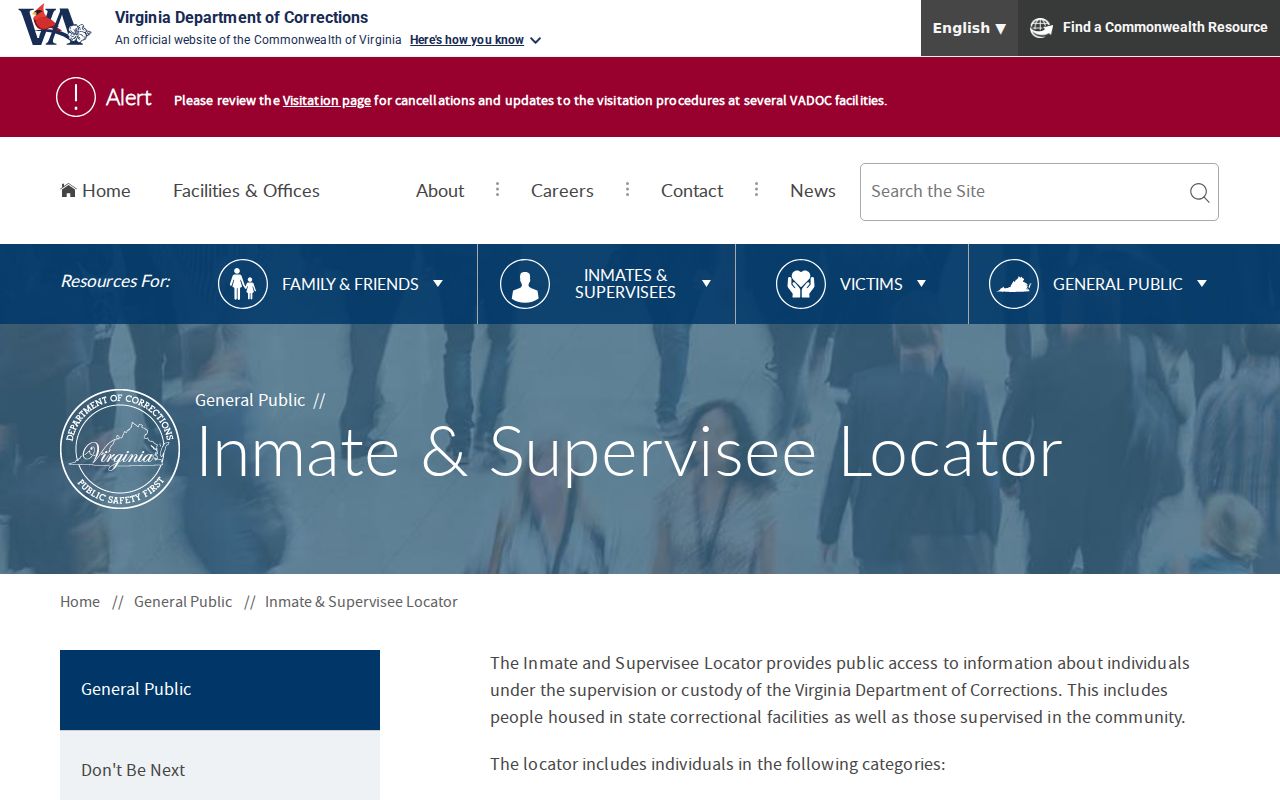
The state locator is a transfer and supervision check, not a substitute for the Prince George County criminal court judgment.
The Prince George Sheriff page documents the local transport and court-process side of the same record chain.
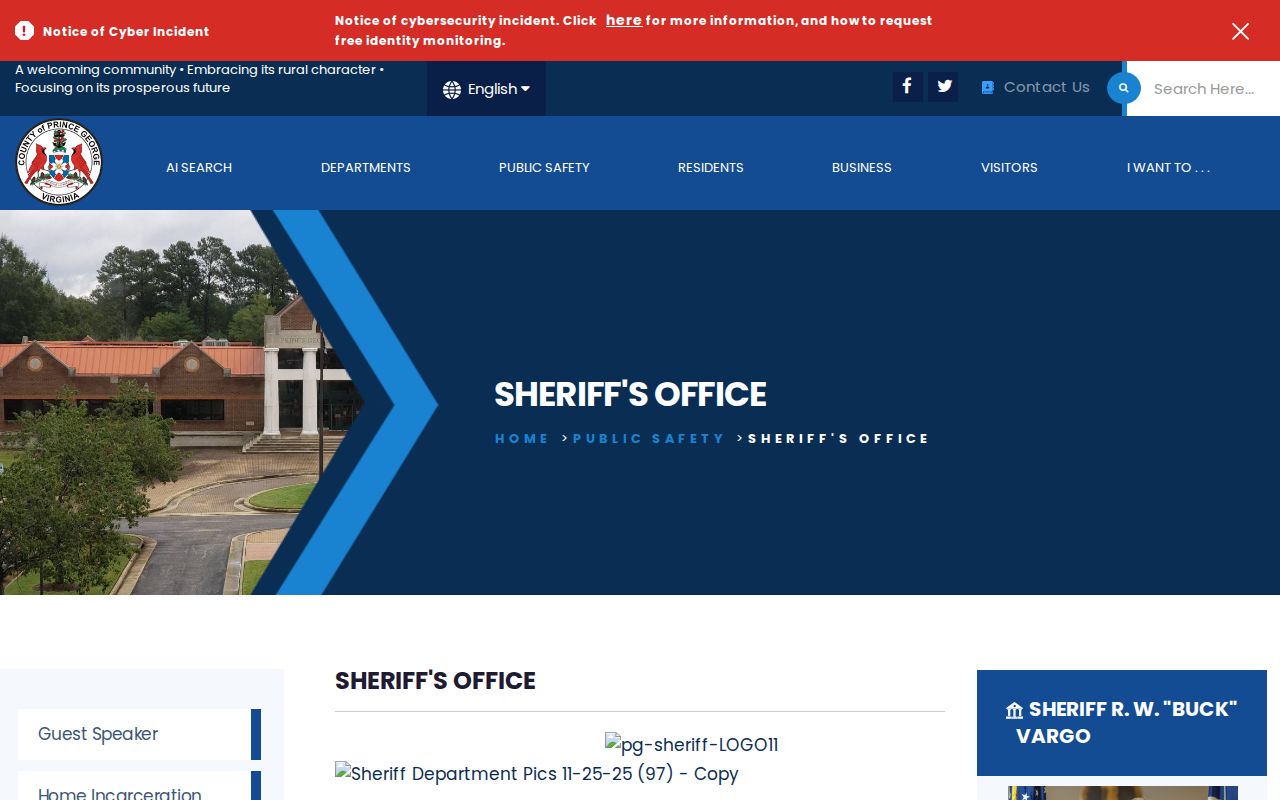
Together, the Army, VADOC, sheriff, court, police, and jail sources show why a Prince George record search must start with jurisdiction and custody level.